Mike Ciannilli
- Prevent Failure Under Pressure: Keep teams focused when risk and complexity rise.
- Strengthen Risk Decisions: Challenge assumptions and protect decision quality.
- Lead Complex Systems: Navigate safety, technology, and automation with discipline.
Mike Ciannilli Speaker Biography
Mike Ciannilli is a former NASA mission leader and expert in how complex programs prevent failure under sustained pressure.
While supporting human spaceflight missions, Mike operated in environments where decisions directly affected mission success, crew safety, and public trust. He saw how programs rarely fail because leaders ignore risk. They fail when risk begins to feel manageable as momentum builds and expectations rise.
Today, Mike equips leaders and teams operating in complex systems to protect decision quality as conditions change. His work focuses on how risk is interpreted, how assumptions are validated, and how discipline is maintained when confidence increases.
His insights are especially relevant for organizations managing safety-critical systems, rapid technological change, and increasing reliance on automation. He connects mission-level lessons to the realities leaders face as systems grow more complex and the consequences of small decisions increase.
Book this SpeakerFeatured Videos

Speech Topics
Healthcare Audience Preventing Failure: The Test Director Mentality When Lives Are on the Line
In an operating room or emergency department, highly trained professionals with different areas of expertise must perform with precision while working toward a single outcome. Decisions happen quickly.
Communication matters. And when something doesn’t look or feel right, someone needs to say so.
Mike Ciannilli knows that environment from a very different room.
For 30 years at NASA, Mike worked inside the firing room, where hundreds of specialists came together for the final countdown to launch a Space Shuttle. As a NASA Test Director, Mike led 21 launch countdowns in an environment where technical complexity, intense time pressure, hierarchy, and human lives converged.
The environment is different. The dynamics are remarkably familiar.
Using the structure of a Space Shuttle countdown, Mike takes healthcare audiences inside the firing room and introduces the Test Director Mentality, a practical approach to preventing failure when the stakes are high and no single person has all the information.
Failure rarely begins with one catastrophic decision. More often, it develops quietly. A small deviation is explained away. An unusual condition becomes familiar. A concern isn’t voiced. Critical information fails to move through the hierarchy. Each moment may seem insignificant until, together, they are not.
That is why effective leadership in high-stakes environments depends on more than having exceptional people in the room. A Test Director cannot do every job required to launch a spacecraft. Like a conductor who cannot play every instrument, the leader relies on expertise they do not personally possess. Success depends on knowing who is in the room, understanding why their expertise matters, keeping information moving, and recognizing when the person who isn’t speaking may be the person everyone most needs to hear.
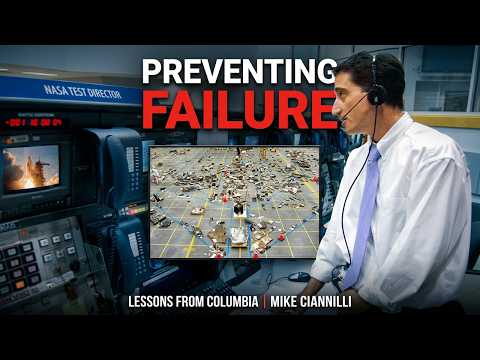
Drawing from 58 Space Shuttle missions, the recovery of Columbia and her crew, and Mike’s later work leading NASA’s efforts to ensure lessons from Apollo, Challenger, and Columbia were understood and applied, Preventing Failure challenges healthcare professionals to look differently at the moments before something goes wrong: who is speaking, who is silent, what is becoming accepted, and what deserves one more question before continuing.
Because when lives are on the line, having the right expertise in the room isn’t enough. The right information has to reach the right people in time.
Audience Takeaways
Participants will:
• Apply the Test Director Mentality to recognize and respond to developing risk before consequences become irreversible.
• Recognize how hierarchy, familiarity, assumptions, and pressure can interfere with critical information reaching the people who need it.
• Keep expertise and concerns moving across roles and levels, particularly when questioning or stopping may be difficult.
• Pay attention beyond spoken words to silence, hesitation, tone, body language, and other signals that something deserves another question.
Ethics Audience Preventing Failure: Recognizing Ethical Drift Before the Decision Is Made
Most ethical failures don’t begin with someone deciding to do the wrong thing. They begin much earlier.
A standard shifts slightly. An exception is made because the circumstances seem to justify it. Something that once would have raised concern becomes familiar. Each step seems small enough to accept, until an individual, team, or organization finds itself somewhere it never intended to be.
Mike Ciannilli calls this drift.
For 30 years at NASA, Mike worked in an environment where decisions carried extraordinary consequences. As a NASA Test Director, Mike led 21 Space Shuttle launch countdowns and supported 58 missions. His work also brought him face-to-face with the consequences of failure through the recovery of Columbia and her crew and his later leadership of NASA’s efforts to ensure the lessons of Apollo, Challenger, and Columbia were understood and applied.
In Preventing Failure, Mike takes audiences inside the events leading up to the Challenger tragedy to examine how capable, committed people, operating under increasing pressure, can gradually move away from the standards and values they believe they are protecting.
As Mike puts it, “When enough heat and pressure is applied, we become malleable.”
Values can bend. Boundaries can move. An exception becomes easier to justify because a similar exception worked before. What once triggered concern becomes familiar. And by the time an organization faces what appears to be a defining ethical decision, the conditions influencing that decision may have been developing for months or even years.
The final decision isn’t where the story begins.
Mike challenges audiences to look further upstream. Where did the drift start? What changed along the way? What became acceptable that wouldn’t have been acceptable before? Who sensed that something didn’t feel right? What pressures made another small deviation seem reasonable?
More importantly, would you recognize those same signals in yourself, your team, or your organization?
Through the lessons of the Challenger disaster and three decades of real mission experience, Mike gives audiences a practical way to develop the self-awareness needed to notice drift early, question what is becoming normal, and respond while there is still time to change direction.
Because protecting your values doesn’t begin when you are confronted with an obvious ethical choice, it begins when the first small deviation still feels easy to explain away.
Audience Takeaways
Participants will:
• Recognize ethical drift as a gradual process that can begin long before an obvious ethical decision or failure.
• Develop greater self-awareness at the individual, team, and organizational levels to recognize when standards, boundaries, and accepted behaviors begin to shift.
• Identify warning signs of drift, including rationalization, normalization, silence, and the instinctive signal that “this doesn’t feel right.”
• Examine how pressure, culture, hierarchy, and previous success can make the next deviation easier to accept.
• Apply the Test Director Mentality to pause, question, and respond before incremental drift becomes consequential failure.