How to Choose a Speakers Bureau
A buyer’s guide for event planners, HR leaders, and association organizers

The short answer
Choose a speakers bureau the way you’d choose any agency: by how well it understands your event, how clear it is about cost, and how much of the work it takes off your plate. A good bureau sends a short, relevant list of speakers quickly, puts every term in a written contract, and stays involved from booking through the day of the event.
Before you commit to a bureau, get clear answers to five questions:
1. Will I pay anything beyond the speaker's fee and travel?
The answer should be no.
2. How knowledgeable is your bureau about all potential speakers that fit with my event?
Industry expertise and fit is key.
3. Who handles logistics?
Contract terms and conditions, travel, the prep call, AV needs, and day-of contact.
4. What happens if someone cancels?
On your side and on the speaker’s.
5. Can you show me speakers I wouldn't have found on my own?
This is where a bureau earns its place.

What is a speakers bureau?
A speakers bureau is an agency that connects event organizers with professional speakers and manages the booking from first inquiry to the event itself. Bureaus work with corporations, associations, universities and nonprofits that need keynote speakers, panelists, moderators, emcees or workshop leaders.
A bureau is different from a speaker’s own manager or agent. A manager works for one speaker or a small group. A bureau usually has access to hundreds or thousands of speakers and should recommend the best fit for your event, not just the people it represents.

Most bureaus do four jobs:
• Recommend. You describe your audience, goals, budget and date. The bureau sends a shortlist of speakers who fit, often including names you didn’t know to look for.
• Confirm. The bureau checks availability, confirms the fee and holds the date.
• Contract. The bureau writes the agreement and handles payment to the speaker.
• Coordinate. The bureau arranges the prep call between you and the speaker, sorts out travel and AV, and stays your contact if anything changes.

Does a speakers bureau cost more?
No. You pay the speaker’s published fee whether you book through a bureau or directly, so the shortlist, contract handling and logistics support come at no added cost to you.
Your total cost is the speaker’s fee plus travel. Travel is typically billed separately, either as actual expenses or as a flat travel fee quoted up front. For what speakers charge by experience level and topic, see our fee page.
Should you use a bureau or book a speaker directly?
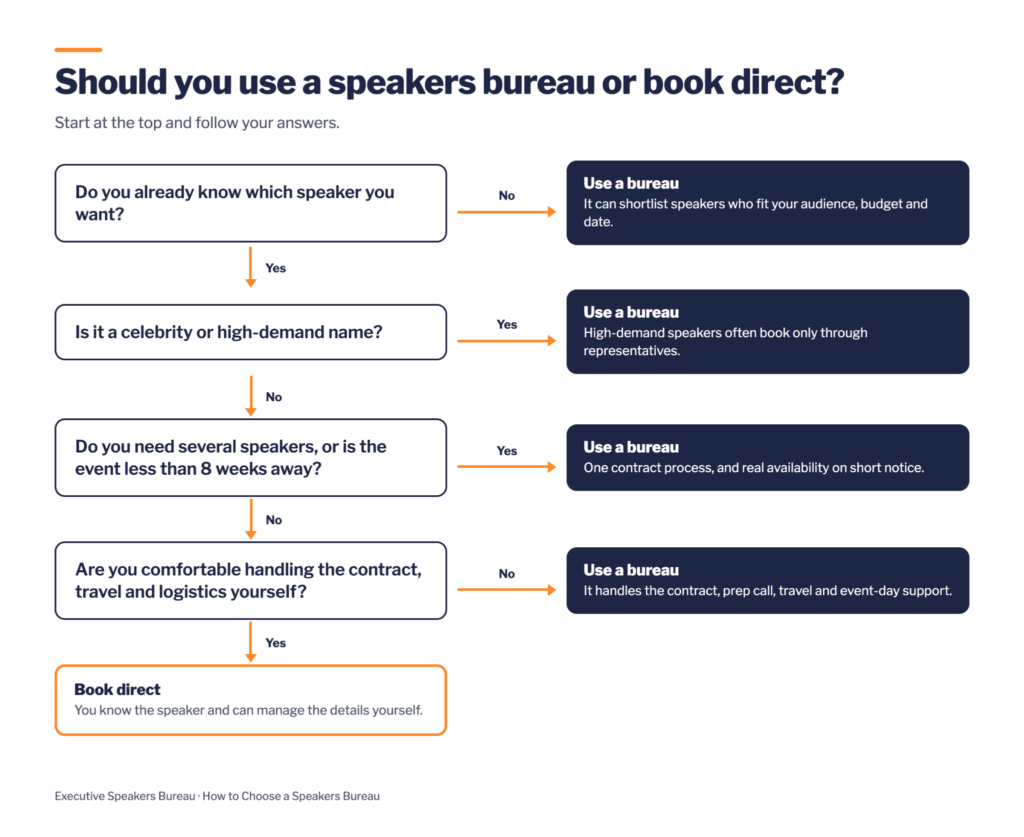
Use a bureau when you don’t yet know who you want or don’t have time to manage the booking. Book directly when you already know the speaker, have a relationship with them, and are comfortable handling the contract and logistics yourself.
| Your situation | Better fit | Why |
|---|---|---|
| You know the goal but not the speaker | Bureau | A bureau can compare dozens of options against your budget and date in a day or two. |
| You need several speakers for one event | Bureau | One contract process and one point of contact instead of three or four. |
| Your date is less than 8 weeks out | Bureau | Bureaus know who is actually available and can move fast. |
| You want a celebrity or high-demand name | Bureau | These speakers often book only through representatives, and large fees deserve careful contracts. |
| You already know the speaker personally | Direct | The relationship is already there. |
| The speaker is local and the fee is small | Direct | Many local or emerging speakers handle their own bookings. |
One more point in a bureau’s favor: if a booked speaker cancels, a bureau can usually propose a replacement of similar caliber. If you booked direct, finding a substitute is on you.
Before you contact a bureau: write a short brief
A bureau’s shortlist is only as good as what you tell it. Ten minutes on a brief saves days of back-and-forth, and sending the same brief to every bureau makes their answers easy to compare.
| Include | Example |
|---|---|
| Date and location | March 12, Nashville, in person |
| Audience | 400 regional sales managers, most with 10+ years in the role |
| Goal | Re-energize the team after a hard year and set up the new sales process |
| What success looks like | Attendees leave with one habit they’ll use the following Monday |
| Format and length | 45-minute keynote plus 15 minutes of Q&A |
| Budget | A range, not a ceiling, plus travel |
| Must-avoids | Topics, styles or speakers you’ve used recently |
Copy-and-paste request:
Hi, we’re planning [event] on [date] in [city, or virtual] for [audience size and type]. The goal is [goal]. We’re looking for a [format and length], and our budget is [range] plus travel. We recently had [past speakers] and want something different. Could you send 3 to 5 speakers who fit, with a sentence on why each one fits, their fee range and their availability?
Types of speakers bureaus
Bureaus differ in how much service they provide, how big they are, and whom they represent. None is better across the board; the right one depends on your event.
| Type | What it means | Best for | Watch for |
|---|---|---|---|
| Full-service | Handles recommendations, contract, prep call, travel and day-of contact | Corporate events, conferences, first-time buyers | Make sure the service is real, not just a phrase on the website |
| Transactional | Confirms the speaker and processes the contract; you handle the rest | Experienced planners who want speed | Gaps in logistics show up the week of the event |
| Large bureau | Big rosters, many exclusive celebrity and political speakers | Very high-profile names, global events | Less personal attention on smaller budgets |
| Boutique or mid-size | Smaller team, often broad access through partner bureaus | Mid-range budgets, planners who want one consistent contact | Confirm they can actually reach the speakers they list |
| Exclusive roster | Represents a set group of speakers directly | Booking one of those specific speakers | Recommendations may lean toward their own roster |
| Open access | Books any speaker who works with bureaus | Planners who want the widest choice | Ask about their relationship with each recommended speaker |
Many bureaus mix these. A mid-size bureau might exclusively manage a few dozen speakers while booking thousands more through open access. Ask which category each recommended speaker falls into.
How to evaluate a speakers bureau: a 9-point scorecard
The best way to judge a bureau is to send the same request to two or three and compare what comes back.
| Criterion | What good looks like | Weight |
|---|---|---|
| Relevance of the shortlist | 3 to 6 speakers who fit your audience and goal, each with a reason why, not just the biggest names in your budget | 20% |
| Understanding of your event | They asked about your audience, goal and format before recommending anyone | 15% |
| Speaker vetting | They’ve watched each speaker’s full talks, not just highlight reels, and track feedback from past clients | 15% |
| Honest relationships | They tell you whether each speaker is exclusive to them, a regular partner, or booked through another party | 10% |
| Clear pricing | Fee range, what’s included and travel terms in writing, with no surprises later | 10% |
| Contract quality | Deposit, payment schedule, cancellation, recording rights and substitutions spelled out | 10% |
| Logistics support | A named contact for the prep call, travel and event day | 10% |
| Speed | Initial ideas within a business day or two | 5% |
| Track record | Years in business, references from events like yours, and membership in the Global Speakers Industry Association – GSIA (formerly known as IASB), whose members agree to a code of professional conduct | 5% |
Score each bureau from 1 to 5 on every row, multiply by the weight, and add it up. The total matters less than the first three rows: a bureau that scores low there is guessing, however fast or friendly it is.

Questions to ask a speakers bureau before you book
Copy these into your first email. A good bureau will answer all of them without hesitation.
If you ask only one question:
“Which of these speakers fits this particular audience best, and why?” A bureau that can answer it knows its speakers. Every great speaker is right for some rooms and less right for others.
About the bureau
- Will I pay anything above the speaker’s published fee and travel?
- Are you a member of the GSIA or another industry association?
- Are client deposits held in a separate account until the speaker is paid?
- Can you share two references from events similar to mine?
About the speaker
- What is your relationship with this speaker?
- Have you booked them before, and how did it go?
- Has the speaker presented to an audience like mine, in industry, seniority and size?
- Can I see recent full-length video, not just a highlight reel?
- Will the speaker customize the talk for my audience, and how?
- Is a prep call with the speaker included before the event?
About the contract
- What deposit is due at signing, and when is the balance due?
- How is travel billed: actual expenses or a flat fee? What class of airfare?
- What happens if I cancel, or if the speaker cancels?
- Do I approve any substitute speaker before they’re confirmed?
- Can we record or livestream the session, and can we share it afterward?
- Will the speaker sign a confidentiality agreement if we share internal material?
- Is a book purchase, meet-and-greet or virtual follow-up included or extra?
Contract terms to understand
The contract is where most booking problems are prevented or created. Read these terms closely before you sign.
| Term | What it covers | What’s common |
|---|---|---|
| Deposit | Payment that holds the date | 50% at signing |
| Balance | Remaining fee | Due before the event, often 30 days out |
| Travel | Flights, hotel, ground transport, meals | Actual expenses billed after, or a flat fee quoted up front; airfare class and change fees stated |
| Client cancellation | What you owe if you cancel | Deposit usually non-refundable; full fee may be due close to the date |
| Speaker cancellation | What happens if the speaker can’t come | Full refund, or a comparable replacement you approve |
| Substitution | Who chooses a replacement speaker | You approve any substitute in writing |
| Force majeure | Events no one controls, like severe weather or emergencies | Rescheduling or a switch to virtual, defined in writing |
| Recording rights | Filming the talk for later use | Often restricted or priced separately; ask before the event |
| Livestream and virtual rights | Streaming to remote attendees or posting online | Usually separate from in-room recording rights |
| Confidentiality | Internal material you share with the speaker | A confidentiality clause or NDA if you share strategy, financials or unreleased news |
| Program details | Length, format, topic, AV needs | Should match what you discussed; put it in the contract, not just email |
| Future bookings | Booking the same speaker again later | Usually goes through the same bureau |
If a term matters to you, such as recording the keynote for your intranet, raise it before signing. It’s far easier to add then than a week before the event.
What happens after you book
Most bookings follow a timeline like this:
| When | What happens |
|---|---|
| At signing | Contract signed and deposit paid; the date is confirmed; Speaker marketing materials are sent. |
| 4 to 8 weeks out | You send agenda, audience, company priorities, anything to reference or avoid |
| 2 to 4 weeks out | Prep call with you, the speaker and the bureau, usually about 30 minutes |
| 1 to 2 weeks out | Travel, AV needs, introduction and run-of-show confirmed |
| Event day | Bureau contact on call for travel delays or last-minute changes |
| After the event | Debrief with the bureau and share attendee feedback, so future recommendations improve |
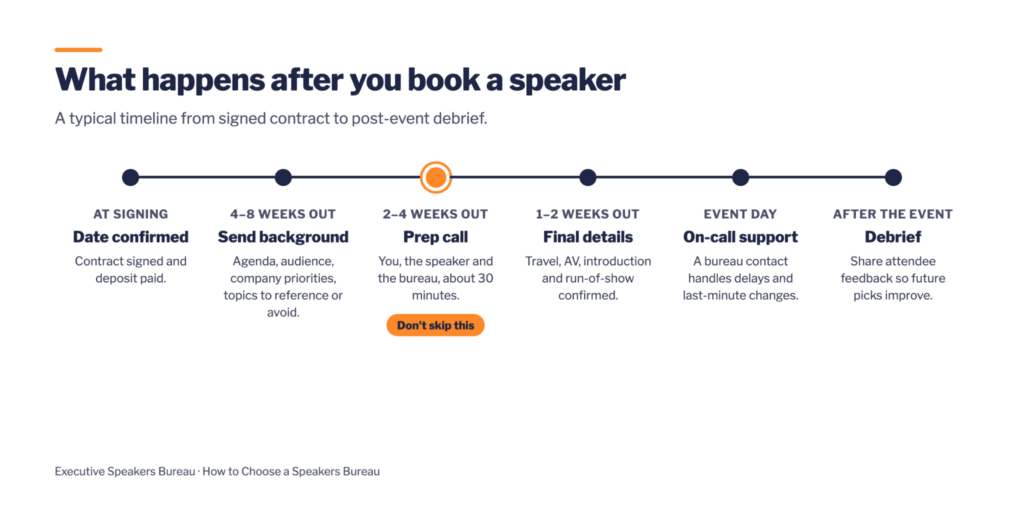
The prep call is the easiest step to skip and the one most worth protecting. It’s where the speaker learns your audience well enough to customize, so put it on the calendar when you sign.
Red flags when choosing a speakers bureau
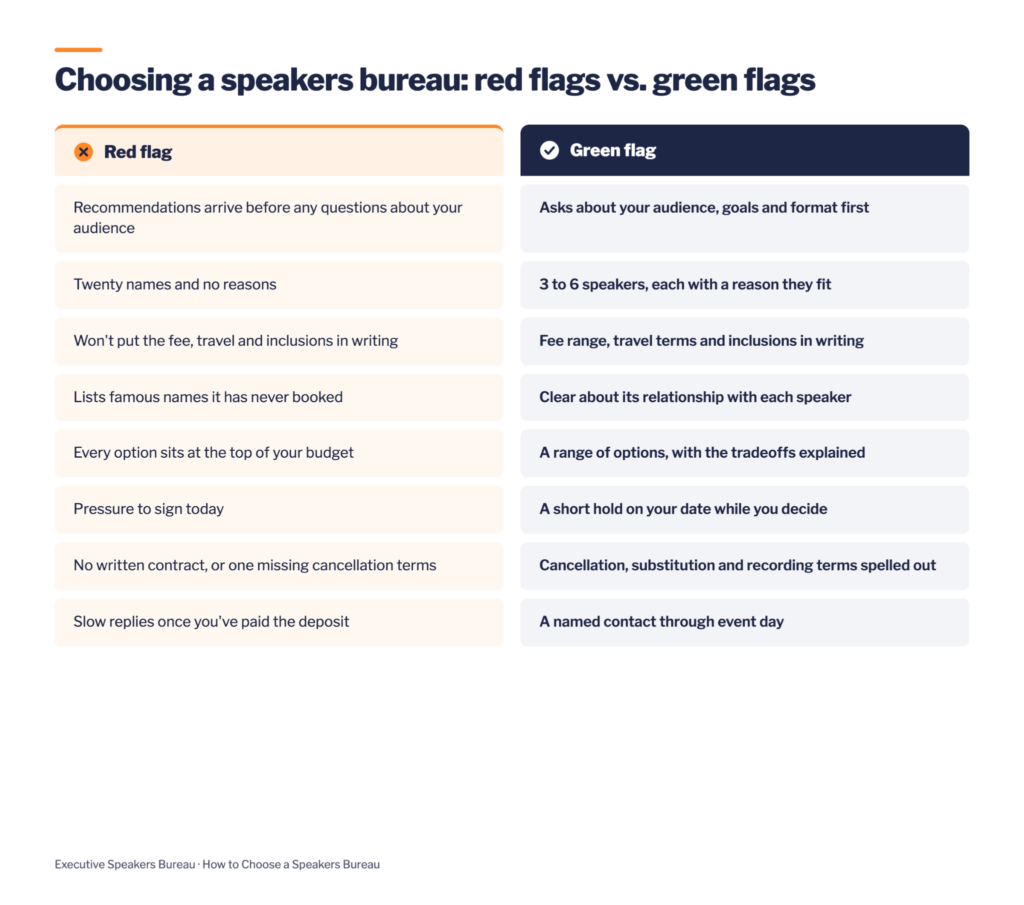
Walk away, or at least slow down, if you see any of these:
They don't ask about your audience.
If recommendations arrive before any questions about who’s in the room and why, the bureau is guessing.
Twenty names, no reasons.
A long, unexplained list hands the work back to you. A good shortlist is short and explained.
Vague answers about cost.
If a bureau won’t put the speaker’s fee, travel terms and what’s included in writing, assume there are costs you haven’t seen.
Speakers they can't actually book.
Some bureaus list famous names they have no relationship with. Ask directly whether they’ve booked that speaker before.
Every recommendation sits at the top of your budget.
A good bureau shows a range and explains the tradeoffs.
Pressure to sign fast without a hold.
Bureaus can usually place a short hold on a date while you decide.
No written contract, or one missing cancellation terms.
Handshake deals protect no one.
Disappearing after the deposit.
If response times slow once you’ve paid, expect the same on event day.
Frequently asked questions
No. You pay the speaker’s published rate either way, and the bureau’s shortlist, contract handling and logistics support come with it.
Four to six months ahead gives you the widest choice. High-demand speakers can book up a year out, but a bureau can still fill dates a few weeks away.
Most speakers who work with bureaus can be booked through any reputable one. Speakers with exclusive representation still can, but their exclusive bureau will be part of the process.
Often, yes. Most bureaus can reach speakers beyond their published roster through partner bureaus and direct relationships. If you have someone specific in mind, ask; a reputable bureau will tell you plainly if it can’t book them.
An agent or manager represents one speaker or a small group. A bureau works with many speakers and should recommend the best fit for your event.
It’s fine to ask two or three bureaus for ideas. Once you choose a speaker, book through one bureau so there’s no confusion about who holds the date.
Yes. Most speakers offer a virtual version of their program, usually at a lower fee than in person. The bureau handles the tech check and run-of-show the same way it would for a live event.
Your date, location, audience size and type, event goal, session length and budget range. The more specific you are, the better the shortlist. The brief template above gives you a version to copy.
This guide is published by Executive Speakers Bureau, a full-service speakers bureau founded in Memphis, Tennessee, in 1993. We wrote it to be useful whether or not you book with us.