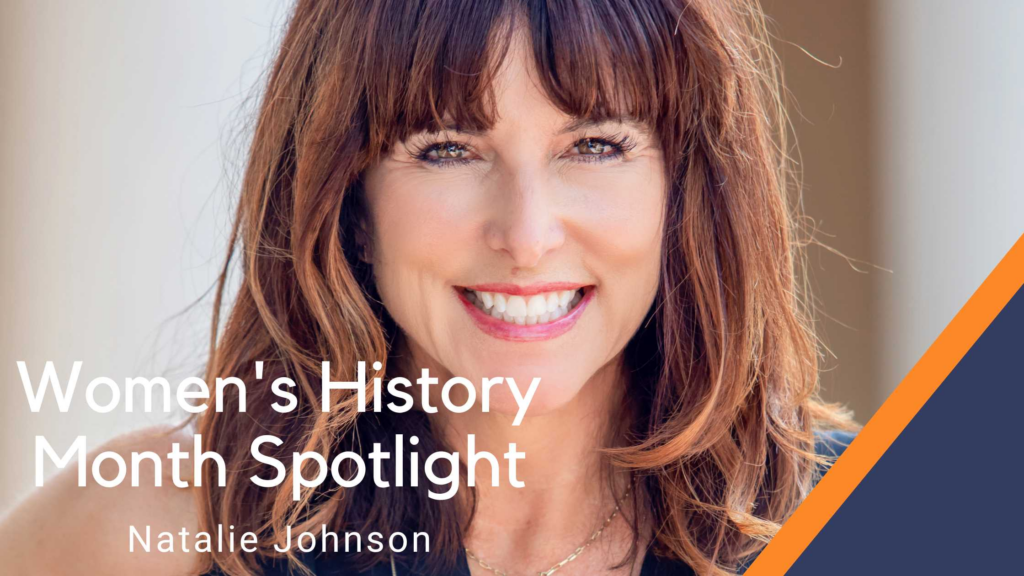
Women’s History Month Spotlight: Natalie Johnson, Co-Founder and Chief Visionary of ViDL Solutions
To celebrate Women’s History Month, we are highlighting another woman leading her industry: Natalie Johnson. As the Co-Founder and Chief Visionary of ViDL Solutions, she uses her decades of experience in sports and career coaching to help people find a higher level of personal performance.
In a recent interview, Johnson shares how she built a career for herself, the women that inspired her, and how she’s sharing her knowledge and skills with the next generation of aspiring women.
Q: How did you decide to enter your career field?
A: I was originally an expert in human performance, where I mostly worked with athletes to help them maximize their performance. A few years into my career I realized everything we teach athletes translates to everyday people who need to perform at high levels for their careers or anything in their personal life. I transitioned over to working with corporations and have been helping people reach their full potential for the last 25 years.
I decided to work with people and leaders instead of focusing on athletes for several reasons:
- The world of sports was very prescriptive at that time. I was telling athletes what to do, and they would do it. But when the season was over, they would drop most of the behaviors and practices that helped them. I realized that telling people what to do only works in the short term and doesn’t leave a lasting impact. I wanted to inspire, not tell people what to do.
- I realized that people who work a more traditional job are expected to perform at a higher level for a longer period of time. Athletes need to perform at their highest level in competitions (which are typically only about an hour). But working professionals have longer days that all add up to bigger career goals. They are expected to perform at a high level all the time while facing high demand, change, and stress. People like me (non-athletes) could benefit from strategies to help them succeed for longer periods of time.
- I wanted more meaningful work. I wanted to be able to inspire people within their lives, not just in a game.
It’s these three reasons that ultimately lead me to my current career where I inspire and support people to create lifelong behavior changes that align with their people and their goals.
Q: What do your career and your industry mean to you as a woman?
A: I can work in what was previously known as a “man’s world” (Corporate America) and succeed by using what comes more naturally to me as a woman. What’s lacking in some corporate environments is the ability to listen, create empathy, lead with curiosity, be ok with emotional experiences at work, and recognize the power of connection over authority. These are all more female-comfortable skills.
Men have traditionally been raised and groomed to be tough, in charge, and lead with power and authority. Because of this, it’s my opinion that it’s more difficult for men to show emotion, be empathetic, have hard conversations, and lead with connection. They can absolutely do these things, but it’s more difficult. They have been raised to believe that it’s not “manly” or appropriate behavior for men.
I see tremendous opportunities today for women to learn and lead in a new way. Women can show up and lead with care, compassion, and understanding. We can lead in a way that will support connection and purposeful decision-making, and eventually, create a new way of working for all.
Q: Did/Do you have any women role models or mentors?
A: Yes, the mentor that stands out the most is my mom. She was a nurse early in her career and later transitioned to a field of health and wellbeing while integrating her nursing experience. She took a big risk by choosing to leave healthcare and start a fitness club in the 1980s. Because of this, I grew up with my mom owning a business.
Her fitness business grew over the years, and I had the opportunity to observe what it took to be a leader and contributor in a successful business. What I remember most was that when my mom was present at her business, it ran the best. My mom is very caring, compassionate, positive, and optimistic. All those characteristics were contagious when she was around.
Although owning a business and having three kids wasn’t easy, she led with compassion and positivity and ran a successful business for many years. Her definition of success was having happy, connected employees who took pride in their work, therefore creating amazing experiences for their customers.
Q: How have women supported you along your career journey?
A: Keynote speaking has given me a wonderful opportunity to work with many associations that support women like Healthcare Businesswomen Association (HBA), International Women’s Forum (IWF), Women in Communications and Technology (WICT), and many women’s leadership events. What stands out to me the most is that they are my biggest support systems and fans.
As a professional speaker, I absolutely love my women audiences the most. They come in with contagious energy and enthusiasm and are active and engaged audiences. They are also the loudest audiences and the most emotional. When I have women audiences, it makes me feel like what I’m doing matters. It’s during these events that we collectively experience joy, connection, compassion, excitement, and appreciation. And there are often many tears, most times in as short as an hour.
This is always how it’s been. For as long as I’ve been speaking, my woman audiences have always been the extraordinary experience I seek.
Q: How do you support women in your field?
A: As I mentioned above, I support women through my speaking and training. I also support women through mentorship. I’m a graduate of Florida State University, and I’ve worked in academics throughout my career at San Diego State University and the University of South Florida. I most enjoy my official and unofficial roles over the years as a student mentor. My mentorship currently includes working with students at Florida State University through their ProfessiNOLE mentor program, and connecting students with alumni for professional support. I also partake in their Unconquered Scholars program which is about 150 students at FSU who experienced foster care, homelessness, relative care, or have been a ward of the state. Through both programs, I have only mentored young women. It was not something I requested, but likely young females choose other females as a mentor most of the time. I mentor my students on everything from resume writing and interview skills to mental health strategies and techniques. It’s been my most rewarding experience to date.