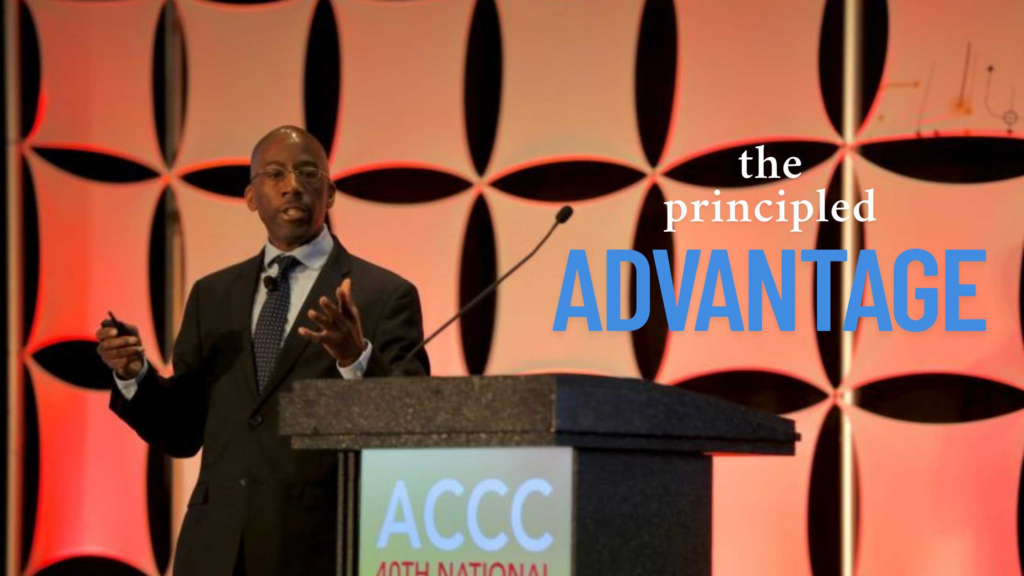
Why do some organizations endure for decades while others lose their way? Leaders have long wrestled with this question, and researchers have sought to explain the patterns. In my own experience leading teams and advising organizations, I’ve found that organizations that last are guided by principle. Their decisions consistently reflect their purpose and the people they serve. It’s something I’ve named the Principled Advantage™.
At its core, the Principled Advantage™ is the discipline of aligning choices with mission. An organization’s mission should live in the halls, not just on the walls. When decisions reflect values, they build trust. That trust deepens loyalty and shapes a culture where people are engaged and committed. Leaders and teams are able to navigate complexity with confidence because the basis for decisions is already defined. Over time, principle becomes the steady force that drives growth.
Purpose as the Anchor
In today’s environment, organizations face constant pressure to scale quickly. Markets reward short-term gains, investors demand fast results, and leaders are urged to expand before consolidating. Yet the most enduring organizations embrace a different path. They get better before bigger.
Consider Patagonia, which has resisted shortcuts that compromise environmental stewardship, leading to a stronger brand. Johnson & Johnson has relied on prioritizing patients, employees, and communities before shareholders, a philosophy that has earned long-standing trust. Costco has been recognized for competitive pay, benefits, and member value; this commitment has helped build broad loyalty. Mayo Clinic is often cited as a global healthcare leader for anchoring decisions on a clear principle: the needs of the patient come first, which has reinforced its reputation worldwide.
In each case, principle guided the path to growth. By ensuring quality, consistency, and alignment first, these organizations made themselves stronger. Their example shows that sustainability is not built on speed, but on values.
Defining the Decision Compass
The Principled Advantage™ begins with clarity. Every organization must define the criteria by which decisions will be judged. These criteria should flow directly from mission and values—not from quarterly targets or transient trends. Without a decision compass, leaders risk inconsistency, which erodes trust over time. When values are explicit, they guide daily behavior and make principle the operating system of the organization.
Putting Principle into Practice
The question for leaders is not whether principle matters, it’s how to make it operational. These steps can help.
First, make the mission visible in decisions. When choices are explained through the lens of values, people see that the mission is not abstract. Even small operational calls can be framed in this way: we chose this vendor because their standards match ours, or we slowed this rollout to preserve quality for those our clients.
Second, build alignment into systems. Principles should be reflected in hiring criteria, performance metrics, and recognition. If collaboration is a value, it must show up in evaluation. If safety is a priority, it must influence incentives. Without alignment, principles remain words rather than standards.
Third, practice consistency under pressure. This is the hardest test. Short-term gains often tempt leaders to cut corners. Declining those shortcuts signals that principle is more than a talking point. Teams watch closely in these moments, and trust is either strengthened or lost.
Applied this way, the Principled Advantage™ becomes more than philosophy. It becomes the compass for daily choices and the filter for opportunities. Leaders who take this approach create organizations that can expand without losing their core, and that’s what enables them to last.
Dr. Ted James is a nationally recognized keynote speaker on leadership, innovation, and organizational transformation. As a physician executive, Harvard program director, and business strategist, he helps leaders across industries drive change, foster innovation, and build high-performing cultures that last.